Plant Propagation
EFB 437/637
Complete Course Schedule
In traditional horticulture programs such as those at Cornell, Penn State, Virginia Tech, UMass, UConn, et. al., "Plant Propagation" is typically a capstone course as it requires an understanding/awareness of foundational knowledge in plant physiology, plant nutrition, plant anatomy, and plant pathology, as well as greenhouse and nursery management, and at least introductory soil science.
"WHAT . . . . wait . . . . that's way more stuff than I need to know just to propagate the occasional African Violet or jade plant," you might be thinking? The good news - or not - is that this class won't be as commercial-scale propagation oriented as courses in full-fleged horticulture programs. However, we're still going to cover a lot of material, so let's get right to it!
To read a thorough description of what we'll be doing during each class/lab session, click on the Week/Date line. You can also download and print a three page, legal-sized .pdf version of the schedule by clicking here.
(Note: If you would prefer to view the course schedule in a compressed format without the complete daily narrative, click here.)
Because we have so much material to cover in fifteen weeks, my hope is that the information available on this this course website - which you can access 24/7 from your phone, tablet, or computer - will answer many/most/all of your questions.
Therefore, we're not going to spend a significant amount of time reviewing the syllabus, the course schedule, the required textbook, etc., during this first class.
Rather, I want to focus on . . . . ,
- Why you're taking this class?
- What are your expectations for how the class will function?
- What would you like to be able to do after taking this class that you can't do now? (Note: this doesn't necessarily need to be only propagation-related - e.g., learn to use "Prezi," learn to make an instructional video, etc.)
- And possibly most important, how can I help you realistically assess/measure your learning over the course of the semester?
I will also briefly introduce you to references you will find to be helpful as we progress through the semester. For additional information on several of these resources, you'll want to watch the Chapter 1 videos.
Finally, one quick reminder. You'll also want to start working through the Chapter 2 content (readings, video lectures, etc.) on the seedling and clonal life cycles as we'll start discussing them in class next Wednesday.
We'll start the class by breaking into small groups to discuss the Chapter One videos 1 through 6 and videos 2-1 and 2-2 (but excluding video 7). Each group will then share thoughts on their assigned resource and as a class we'll then compare them to plant propagation-related consumer magazine articles and the writings of amateur bloggers.
We'll end the class with a short, low-stakes (ten possible points) quiz (Quiz #1) focusing on the course syllabus and the propagation-related references we just discussed. (Note: Wednesday quiz scores are normally due to me by midnight on Sunday evenings. However, because we do not meet on Monday, January 21 in honor of Martin Luther King, the first quiz score will be due via email by midnight this coming Monday evening.)
(Note: to prepare for group discussions and quizzes it will be helpful to spend some time considering the questions posed at the end of each video lecture.)
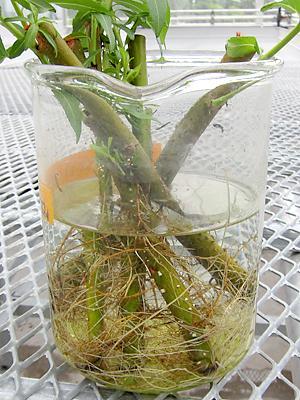
Stems, however, are not the only structures that can be used as cuttings. During this lab session we will also clonally propagate a number of species by leaf cuttings and root cuttings.
For more information on this lab session including treatment rubrics and video instructions, click on this link Lab Session #1 - Clonal Propagation by Cuttings.
I will also return Wednesday's quiz - ungraded Quiz #1. As you may recall from the syllabus, you'll grade almost all of your own work throughout the semester beginning with this first quiz. To guide you through the grading process, you'll find a grading rubric and review video for this quiz here. Please email me your score (between 0 and 10 points) no later than midnight this coming Monday, January 21.
Martin Luther King, Jr. holiday observance - no class. However, remember that your Quiz #1 score must be emailed to me by midnight tonight!
We'll begin the class with a brief review, comments and observations regarding last Friday's cutting propagation lab exercises. (I'm going to sound like a nag, but DO check on all of your lab exercises frequently - ideally daily - to note any changes, take pictures, water, etc.). I'll also gladly address any questions/clarifications regarding the first quiz.
We'll then break into groups to discuss several scenarios associated with the seedling (sexual) and clonal (asexual) lifecycles introduced in Chapter 2 and their relationship to various propagation strategies. Following short group presentations, we'll end the class with a quiz (Quiz #2).
Finally, looking ahead to learning about the many different types of media used in plant propagation beginning next Monday, make sure to read Chapter 3 in the text and watch the Chapter 3 videos. Also make sure to watch the short video clips prepared by students in last year's class in which they offer their thoughts on the various media we'll be studying. (Links to these videos can be found at the bottom of the Chapter 3 content page.) And, you may also find the descriptions of various media components found in Chapter 5 - "Media and Containers for Seed and Cutting Propagation and Transplanting" of the supplemental reference "Plant Propagation: Concepts and Laboratory Exercises" to be helpful?
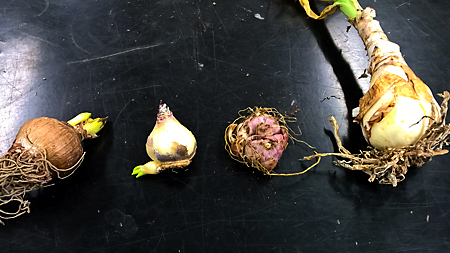
In this lab session we're going to "scoop," "scale," and/or "chip" several bulb-forming geophytes including from left to right in the image at right; amaryllis (Hippeastrum x hybrids), lilies (Lilium x hybrids), hyacinth (Hyacinthus orientalis) and crinum (Crinum x hybrids). (Looking ahead, we will propagate additional geophytic plant species by means of corm, rhizome, tuber, fleshy tuberous root and tuberous stem "division" during Lab #7 on Friday, March 8 - yes, the afternoon just before the beginning of spring break).
For more information on this lab session including treatment rubrics and video instructions, click on this link Lab Session #2 - Bulb Scaling, Scooping and Chipping.
I will also return Wednesday's ungraded quiz (Quiz #2). Again, as will be the case throughout the semester, you'll find a grading rubric and review video for this quiz here. Please email me your score (between 0 and 10 points) no later than midnight this coming Sunday, January 27.
As often will be the case at the beginning of Monday classes, we'll spend a few minutes reviewing the previous Friday afternoon lab session to address any lingering questions, concerns, etc. We'll also discuss observations made on lab exercises currently in progress.
We'll then break into groups and each group will be provided with several of the propagation media introduced in Chapter 3 of the textbook. Groups will have roughly ten minutes to prepare and present a short review of each medium.
Following the group presentations, we'll end the class with the third quiz of the semester (everything covered in the class to date - including pages 90-95 in Chapter 3 and this past Friday's bulb propagation lab exercise).
Finally, looking ahead to Wednesday, you're going to want to read Chapter 6 in the text and watch the Chapter 6 videos as we begin discussing the propagation of plants by seed.
(Note: Given the amount of material that we're going to try to cover this semester, we will not be discussing the content in Chapters 4 and 5 of the textbook. Hopefully, much of the content in those two chapters you will be familiar with from other courses you've taken here at ESF or elsewhere.)
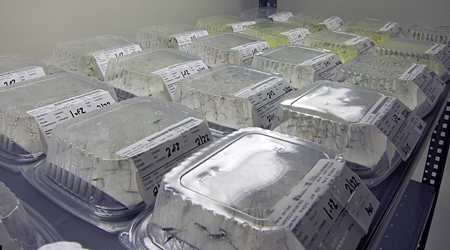
In today's class we'll focus discussions on topics addressed in Chapter 6 and the Chapter 6 videos, including seed harvesting and processing, seed testing (at right) and labeling, seed treatments and seed storage. There will be a quiz (Quiz #3) at the end of class.
Looking ahead, you will want to read Chapter 7 and watch the Chapter 7 video content in preparation for next Monday's class.
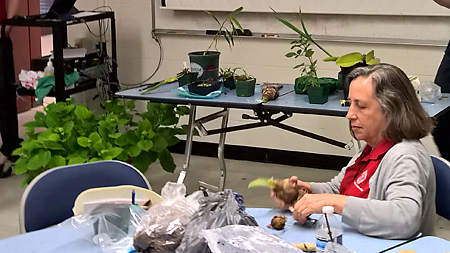
We'll start the day at the Digital Storytelling Studio in 105 Marshall Hall where we'll learn about the resources and equipment that's available for use in putting together the video component of your capstone project. We'll then return to Illick where Karen Bishop (at right), the Cornell Cooperative Extension Master Gardener volunteer coordinator, will join us for about thirty minutes to provide an overview of the program and the 2019 training effort.
We'll then focus most of our efforts building upon the brief propagation media presentations made by you and your classmates during this past Monday's class. We'll discuss in greater detail their advantages and disadvantages, and we'll conduct several relatively simple tests to assess their water retention, drainage, and nutrient-holding behaviors.
For more information on this lab session including treatment rubrics and video instructions, click on this link Lab Session #3 - Capstone Project Introduction and Propagation Media.
I will also return Wednesday's ungraded quiz (Quiz #3). As always, you'll find a grading rubric and review video for this quiz here. Please email me your score (between 0 and 10 points) no later than midnight this coming Sunday, February 3.
We'll end the class with the fifth quiz of the semester.
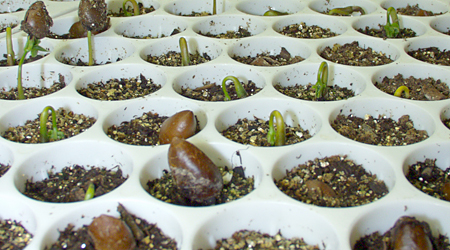
The most difficult part of the entire course for some students is developing a foundational understanding of seed dormancy - i.e., the inability of viable seeds to germinate even when exposed to ideal conditions. We'll spend today discussing this topic using Carol and Jerry Baskin's classic Native Plants Journal article "When Breaking Seed Dormancy Is a Problem" as a guide.
We'll also work through an exercise where each group will have to decode a seed dormancy scenario using the keys found in "Determining Dormancy Breaking and Germination Requirements from the Fewest Seed".
And, I'll return Monday's ungraded quiz (Quiz #5). You'll have until midnight this Friday evening, February 8, to email your score (between 0 and 10 as always) to me, using the Quiz 5 grading rubric and review video at this link.
We'll then end the class with the sixth quiz of the semester.
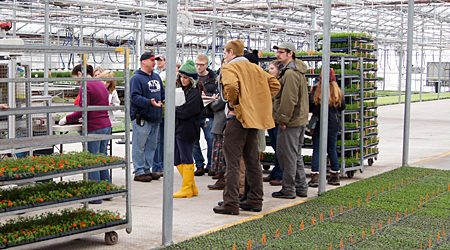
To prepare for this field trip, please review the observations I will expect you to make by going to the Field Trip Observations page. In addition to the opportunity to earn extra credit points, you will want to be prepared to address related questions during future quizzes and exams.
I will also return Wednesday's ungraded quiz (Quiz #6). As always, you'll find a grading rubric and review video for this quiz here. Please email me your score (between 0 and 10 points) no later than midnight this coming Sunday, February 10.
We'll spend the first part of this session reviewing this past Friday's trip to Dickman Farms Greenhouses, then transition to an overall review of topics covered to this point in the semester in preparation for Wednesday's exam.
First Exam!
Content covered will include all assigned readings, videos, and web resources, in-class discussions to date - as well as this past Friday's field trip to Dickman Farms.
Format for the exam will be the same as the six quizzes you've already taken.
I will scan the exams and return them to you at the beginning of this Friday's lab session. You will then grade your own exams by referring to the first exam grading rubric and review video in preparation for a one-on-one exam review with me during the lab session a week from this Friday (that is, Friday, February 22).
Meanwhile, looking forward to next week - and rest of the semester for that matter - we'll be shifting gears from seed (sexual) propagation to vegetative (asexual) propagation. Also referred to as "clonal" propagation, vegetative/asexual propagation techniques (several of which you've already performed in lab sessions to date) include "cuttings," "budding," "grafting," "layering," "division," "micropropagation," etc.
To provide a foundation on which we can build a strong understanding of the clonal propagation techniques mentioned above, please read Chapter 9 in the textbook and watch the chapter videos, too, of course. You will also find Chapter 15 - "Juvenility and Its Effect on Macro- and Micropropagation" in the supplemental reference "Plant Propagation: Concepts and Laboratory Exercises" to be helpful.
Of particular note, the role of juvenility in clonal propagation - especially the concept of the "cone of juvenility" and the differences between chronological and ontogenetic aging - will be very important to grasp.
I'll begin this lab by returning your ungraded exams to you and do my best to answer any questions you may have about the exam itself, the process for self-grading them (including questions about the grading rubric and review video content), and/or the one-on-one meeting you'll have with me during next week's lab in which we'll discuss your grade.
Next, before moving on to the clonal propagation of plants beginning next week and continuing to the end of the semester, we're going to spend the rest of this lab performing a series of treatments on the dormant seed of redbud (Cercis canadensis), one of our most beautiful spring-flowering native trees here in the northeastern U.S.
For more information on this lab session including treatment rubrics and video instructions, click on this link Lab Session #4 - Seed Dormancy.
Watching an entire plant slowly emerge from a seed is nothing short of amazing. However, even after forty years as a professional horticulturalist I still find the appearance of tiny roots on the base of a stem cutting, tiny shoots emerging from a leaf cutting, "bulblets" appearing out of nowhere around the base (technically the "basal plate") of a hyacinth bulb, and/or the successful "budding/grafting" of one plant onto another to be nothing short of miraculous!
All of the events described above are forms of "clonal" propagation - i.e., the vegetative/asexual production of progeny plants that share an identical genotype with a single source (parent) plant. In fact, you've already experienced several forms of clonal propagation in lab sessions earlier in the semester.
We'll jump into clonal propagation - the focus of the rest of the semester - by discussing the relationship between the seedling and clonal lifecycles, the advantages/disadvantages of clonal propagation, possible sources of clones as cultivars, and types of variation within clones.
We'll end the class with a quiz (Quiz #7) covering content from Chapter 9 and related videos and readings (again, note that this content is found in Chapter 16 of the 7th and 8th editions of the assigned textbook).
(Reminder . . . . , please remember to review and self-grade your first exam. I will be meeting with each of you during this coming Friday's lab session to discuss the exam and assign a mutually agreeable grade.)
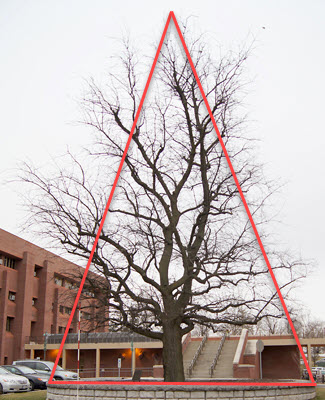
Typically, plants are most easily propagated from cuttings, grafting, layering, etc. within a relatively short period of time (days, to months, to years depending upon the plant) following their germination from a seed. However, even very (chronologically) old plants can retain ontogenetically juvenile characteristics at the "root/shoot junction" formed ("laid down") at the time of seed germination.
We'll complete our discussion by overlaying of the "cone of juvenility" onto examples of various sexually mature plants, including our own `Robin Hood Oak' (at right) to better visualize chronological age versus ontogenetic age and therefore increase your chance of success with clonal propagation techniques.
We'll end the class with a quiz (Quiz #8), and I'll return Monday's ungraded quiz (Quiz #7). You'll have until midnight this Friday evening, February 22, to email your score (between 0 and 10 as always) to me, using the Quiz 7 grading rubric and review video at this link.
And, to prepare for our discussions and lab exercises leading up to the second exam just prior to spring break, please read Chapter 10 and Chapter 11 (and watch the related videos and complete the additional assigned readings). In the supplemental reference "Plant Propagation: Concepts and Laboratory Exercises" you'll find Chapter 14 - "Plant Growth Regulators Used in Propagation" as well as Chapters 17 through 25 (which cover specific components of the material covered in Chapters 10 and 11 of the assigned text) to be helpful.
Today will be very busy for me as I'll be meeting with each of you for roughly ten minutes(ish) to review your first exam effort, assign a mutually acceptable score, and at least briefly discuss the progress you've made on your capstone project (at an absolute minimum I believe you should have a pretty good grasp of the literature and other resources that are available on your topic). I will also return Wednesday's ungraded quiz (Quiz #8). As always, you'll find a grading rubric and review video for this quiz here. Please email me your score (between 0 and 10 points) no later than midnight this coming Sunday, February 24.
And you?
I suggest using today as an opportunity for taking really detailed measurements and making close observations (including pictures) of your ongoing lab projects. As I've said, in past years I've been too forgiving if students didn't make a good effort to keep they're propagules alive (forgetting to water, etc.). That won't be the case this year. To understand how various propagation practices work, you have to keep your plant materials alive!
Last week we discussed the foundational principles of the clonal propagation of plants - including the fundamental role "ontogenetic juvenilty" plays in the ease with which plants can be "cloned."
Today we will focus on the influence of "phytohormones" (especially auxins and cytokinins) on the formation of adventitious roots, buds and shoots in stem, leaf and root cuttings, as well as the sequence of events leading to the formation of these organs.
From a practical perspective we will also discuss the critical importance of "stock plant" management, the treatment of cuttings, and manipulation of the propagation system environment in the successful clonal propagation of plants. It will be emphasized that should you fail to focus sufficiently on any one of these three inputs, the application of a growth regulator (typically auxin) will not result in success.
We'll end the class with a quiz (Quiz #9) covering content from Chapter 10 and related videos and readings (note that this content is found in Chapter 9 of the 7th and 8th editions of the assigned textbook).
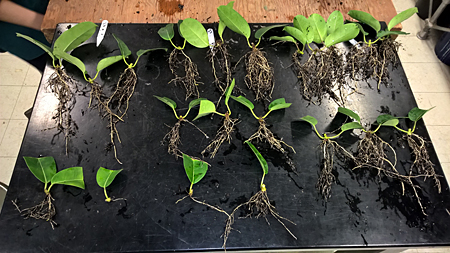
We'll discuss the many different kinds of stem cuttings and when best to use them depending upon the objective of your propagation effort, the condition of the stock plant, the time of year, etc. We'll also discuss the practical applications of leaf and root cuttings.
We'll then turn our attention to process of propagation by cuttings - from the collection and transportation of cuttings, to their treatment with rooting compounds, to their management while forming adventitious organs (roots, buds and/or stems) in the propagation environment be it a humidity chamber, greenhouse bench, outdoor rooting bed, etc.
I'm hopeful that by the end of this class session you will be well-prepared to provide a thorough analysis of the Clonal Propagation by Cuttings (Lab #1) results you're observing (whether good, or not so good). I'm also hopeful that based on our discussions, the readings, and your experience with this lab exercise that you'll be well-prepared to propagate a wide range of plants by cuttings far into the future.
We'll end the class with a quiz (Quiz #10), and I'll return Monday's ungraded quiz (Quiz #9). You'll have until midnight this Friday evening, March 1, to email your score (between 0 and 10 as always) to me, using the Quiz 9 grading rubric and review video at this link.
If all goes according to plan, we will make observations, collect data and terminate the seed dormancy exercise that we initiated on February 15th.
We will then spend rest of this session discussing strategies for creating lab reports that both accurately portray your results, can be used as examples of your analytical and writing skills, and possibly most importantly can be be shared with others that are interested in propagating plants.
Come to this session prepared to write!
For more information on this lab session including treatment rubrics and video instructions, click on this link, Lab Session #6 - Lab Report Preparation.
We'll spend today reviewing the topics we've covered since the first exam including the introduction to clonal propagation concepts and the propagation of plants by means of cuttings in preparation for the second exam of the semester coming up on Wednesday.
Second Exam!
Content covered will primarily include all assigned readings, videos, and web resources, in-class discussions and problem-solving exercises covered since the first exam. However, I won't rule out going back to the first day of the semester in order to reinforce your efforts to tie all concepts together as you work toward a thorough competency in propagating plants.
Once again, the format for the exam will be similar to the first exam and daily quizzes.
As with the first exam and quizzes, I will scan the exams and return them to you at the beginning of this Friday's lab session. You will then grade your own exams by referring to the second exam grading rubric and review video in preparation for a one-on-one exam review with me during the first lab session after spring break (that is, Friday, March 22).
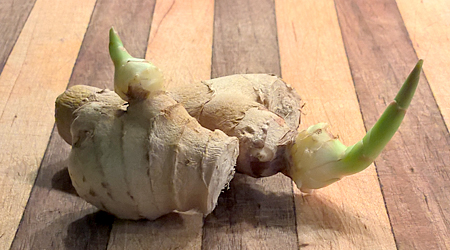
In this lab session we'll propagate several additional geophytic plants using various "division" techniques. The plants will include gladiolus (a "corm"), canna and edible ginger (at right) that both feature "rhizomes," potatoes and caladiums, (both are "tubers"), dahlia (a "fleshy tuberous root"), tuberous begonia (a "tuberous stem"), and coconut orchid ("pseudobulbs").
For more information on this lab session including treatment rubrics and video instructions, click on this link, Lab Session #7 - Geophytic Plant Propagation.
And, before you head out the door make sure that I've returned your ungraded Exam #2! While it's much longer delay than I would prefer, we'll meet to discuss your effort on Friday, March 22. Instead of waiting until the last second to grade your work, I strongly recommend you do it as soon as possible so that your reasoning for the answers you provided are still fresh in your memory.
In addition to grading your second exam, I suggest that you read Chapter 12 - "Principles of Grafting and Budding," in the textbook (Chapter 11 in the 7th and 8th editions of the textbook) and watch the Chapter 12 videos. You will also find Chapter 27 - "Grafting: Theory and Practice" in the supplemental reference "Plant Propagation: Concepts and Laboratory Exercises" to be helpful.
It will also be a good idea to start giving some serious thought to your capstone project, too (not, of course, that you haven't already done so;-)
Welcome back!
Now that spring break is past the end of the semester is just around the corner, therefore we'll jump right into the propagation of plants by means of budding and grafting by working through several group-based, problem-solving exercises. So as to be an active participant in these exercises - and prepared for the quiz at the end of class (yes, the eleventh quiz of the semester, despite just returning from break) - please make sure you've completed the Chapter 12 readings and video lectures before coming to class.
Looking ahead to the next several classes, you're going to want to read Chapter 13 - Techniques of Grafting and Chapter 14 - Techniques of Budding and watch the associated video lectures.
Also remember that you will need to have your second exam graded in preparation for meeting with me this Friday to review it - and to discuss the progress you're making on your capstone project.
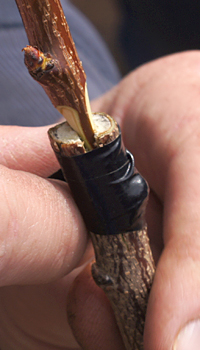
By the end of this class I will expect that if given a scenario, you and your group will be able to offer an appropriate grafting strategy as well as being able to perform the technique for the benefit of your classmates.
We'll end the class with a quiz (Quiz #12), and I'll return Monday's ungraded quiz (Quiz #11). You'll have until midnight this Friday evening, March 22, to email your score (between 0 and 10 as always) to me, using the Quiz 11 grading rubric and review video at this link.
Looking ahead, between now and next Monday, please read Chapter 13 and watch the Chapter 13 videos to develop an understanding of the role "budding" techniques can play in the clonal propagation of plants.
Finally, one more time . . . . . , remember to have your second exam graded in preparation for reviewing it with me on Friday. I am also looking forward to discussing the progress that you're making on your capstone project.
As you'll recall from the February 22 lab session during which we met individually to review your first exam effort, today will be crazy busy for me!!! (The good news is I really do look forward to these opportunities to discuss your effort in the class on an individual basis:-)
To make our time as helpful as possible, make sure that you've got your second exam graded and have a list of confusions ready to discuss. I'll also want to spend a couple of minutes discussing the progress you're making on your capstone project, so having some writing examples ready to share will be very helpful, too.
I will also return Wednesday's ungraded quiz (Quiz #12). As always, you'll find a grading rubric and review video for this quiz here. Please email me your score (between 0 and 10 points) no later than midnight this coming Sunday, March 24.
As for your time during this session, I very much understand how it's easy to treat it as a "day off" (especially on a Friday afternoon). I'm hopeful, however, that you've planned ahead to make this a productive, "self-directed" afternoon of working on lab assignments and your capstone project.
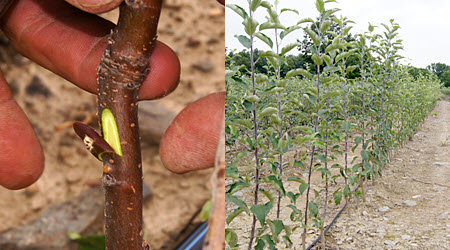
While budding techniques are typically much less complicated (and therefore less perilous to fingers), they are normally performed in the field while bent over at the waist, laying on one's stomach on a low cart, etc. - often under very difficult weather conditions.
We'll end the class with the (lucky) 13th quiz of the semester.
Finally, in preparation for Wednesday's class, you're going to want to have read Chapter 15 - "Layering and It's Natural Modifications" (Chapter 14 in the 7th and 8th editions of the textbook) and watched the Chapter 15 video content. You will also find Chapter 26 - "Layering" in the supplemental reference "Plant Propagation: Concepts and Laboratory Exercises" to be helpful as well.
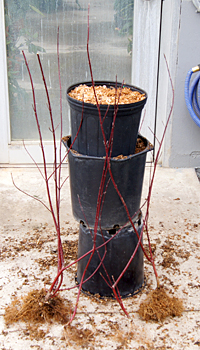
If you didn't take my advice, then you're going to have to rely on your classmates to explain as we'll be breaking into groups to develop short in-class reviews of the various relatively "low-tech" - though highly effective - layering techniques for clonally propagating a wide range of plants. We'll also step out into one of the greeenhouses to unpot several woody shrubs that were layered in May of 2018. If time allows, we may also take a look at the propagation of a variegated rubber tree (Ficus elastica) by air layering.
We'll end the class with a quiz (Quiz #14), and I'll return Monday's ungraded quiz (Quiz #13). You'll have until midnight this Friday evening, March 29, to email your score (between 0 and 10 as always) to me, using the Quiz 13 grading rubric and review video at this link.
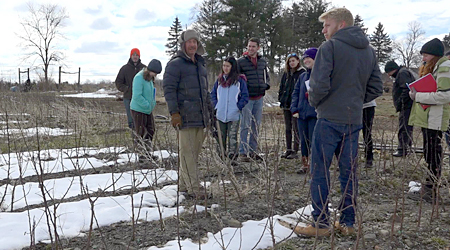
Unless the weather is absolutely awful, we'll walk out into the orchard to observe the scionwood/budwood trees, the production fields (at right), and blocks of producing apple trees. If this works out, you'll have the opportunity to observe firsthand the entire budding/grafting process, and the end product in the field at a bearing age.
To prepare for this field trip, please review the observations I will expect you to make by going to the Field Trip Observations page.
I will also return Wednesday's ungraded quiz (Quiz #14). As always, you'll find a grading rubric and review video for this quiz here. Please email me your score (between 0 and 10 points) no later than midnight this coming Sunday, March 31.
And, with the end of the semester bearing down on us - even if it is only the end of March - please read Chapter 16 - "Propagation by Specialized Stems and Roots" in the textbook and watch the Chapter 16 videos. You will also find Chapter 29 - "Storage Organs" in the supplemental reference "Plant Propagation: Concepts and Laboratory Exercises" to be helpful.
Considering that you've already propagated a number of (geophytic) plants by dividing (for the most part) their modified stems and/or roots during two lab sessions early this semester - Lab Session #2 (Bulb Scaling, Scooping and Chipping) and Lab Session #7 (Geophytic Plant Propagation) - the content we cover today (bulbs, corms, tubers, tuberous stems, and tuberous roots) and Wednesday (rhizomes and pseudobulbs) should be relatively familiar. My hope is that the conversations we have over the next several class sessions will support/strengthen the observations you've made during the lab sessions and will help make sense of the results you obtain when the above labs are terminated on Friday, April 12.
We'll end the class with the fifteenth quiz of the semester.
In addition to root sprouts, stolons, runners and several forms of natural layering, many otherwise stationary plants (what other kind is there, right) have evolved clever strategies for colonizing unoccupied space by growing horizontally instead of vertically. Many terrestrial plants (like the cannas and edible ginger we propagated last month), some marginal aquatic plants, and a few epiphytic plants (e.g., many bromeliads) accomplish this by means of modified primary, horizontal-growing underground stems called "rhizomes." Meanwhile, epiphytic orchids colonize trunks and branches of host plants by means of "pseudobulbs" that form along rhizome-like stems.
Today we'll take a closer look at the propagation of plants by the division of these structures and end with Quiz #17 of the semester.
We'll end the class with a quiz (Quiz #16), and I'll return Monday's ungraded quiz (Quiz #15). You'll have until midnight this Friday evening, April 5, to email your score (between 0 and 10 as always) to me, using the Quiz 15 grading rubric and review video at this link.
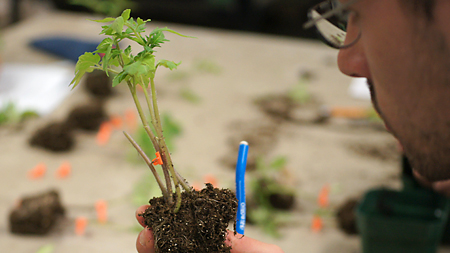
However, don't worry - too much. I do have one bandaid left over from last year - just in case;-)
We'll also tempt fate by performing top and approach grafting (at right, above) of tomato seedlings, as well as building our own "Ketchup 'n' Fries" plants!
Once we get all of the grafting out of the way, we'll terminate the "Clonal Propagation by Cuttings" exercises that we initiated back on January 18th during the first lab session of the semester.
I will also return Wednesday's ungraded quiz (Quiz #16). As always, you'll find a grading rubric and review video for this quiz here. Please email me your score (between 0 and 10 points) no later than midnight this coming Sunday, April 7.
We'll spend today reviewing the topics we've covered since the second exam including grafting and budding, layering, and the propagation of geophytic plants in preparation for the third exam of the semester coming up on Wednesday.
Third Exam!
Content covered will primarily include all assigned readings, videos, and web resources, in-class discussions and problem-solving exercises covered since the second exam. Again, however, don't be too surprised if I go back to a point much earlier semester in order to reinforce your efforts to tie all concepts together as you work toward a thorough competency in propagating plants.
The format for the exam will be similar to the first two exams and daily quizzes.
As with the first two exams and quizzes, I will scan the exams and return them to you at the beginning of this Friday's lab session. You will then grade your own exams by referring to the third exam grading rubric and review video in preparation for a one-on-one exam review with me during the last lab session of the semester on Friday, April 26th.
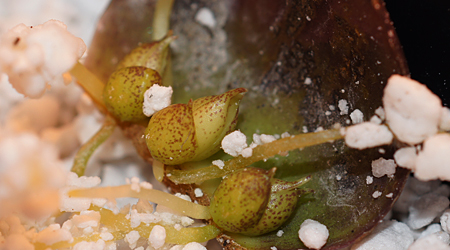
Looking ahead to Monday's class, make sure to complete the assigned Chapter 17 - "Principles and Techniques of Micropropagation from Meristematic Tissue (Axillary Shoot Proliferation)" readings and watch the related video lectures.
Oh . . . . , I almost forgot!
Before you leave make sure that I've returned your ungraded Exam #3! While we'll meet to discuss your effort during the last lab session of the semester on Friday, April 26th, I strongly recommend you review and grade your effort as soon as possible so that your reasoning for the answers you provided are still fresh in your memory.
Finally, we'll also draw numbers for the Master Gardener training session practice presentations to be held during class on Monday, April 22 and Wednesday, April 24.
Specifically, we're going to discuss "aseptic micropropagation" techniques that often begin with a shoot tip "explant" that may be less one-half inch long and has fewer than a half-dozen or so fully developed, pre-formed axillary buds (at right). When successful, a single explant can lead to the production of several dozen to more than one hundred new, genetically identical plants within a year!
We'll end the class with a quiz (Quiz #17).
For Wednesday's class, make sure to complete the assigned Chapter 18 - "Principles and Techniques of Plant Tissue Culture from Nonmeristematic Tissue (Adventitious Origin)" readings. It would also be a good idea to watch the related video lectures a second time!
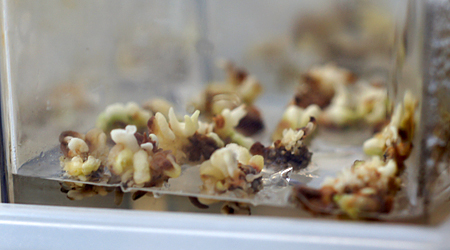
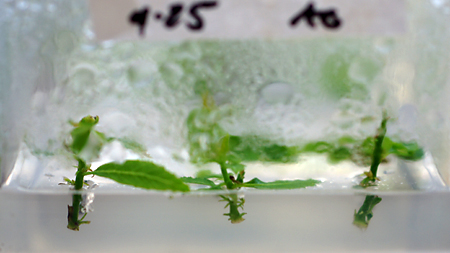
On the other hand, microshoots/cuttings that emerge from non-meristematic tissues such as unorganized "callus" tissues, "rescued" embryos such as those in the image at right, or even from individual cells in a liquid cell culture are potentially less likely to be genetically identical to the plant from which the original tissue was obtained.
In today's class we'll discuss the origin of these "adventitious" shoots and their potential advantages/disadvantages as compared to shoots emerging from pre-formed meristems.
We'll end the class with a quiz (Quiz #18), and I'll return Monday's ungraded quiz (Quiz #17). You'll have until midnight this Friday evening, April 19, to email your score (between 0 and 10 as always) to me, using the Quiz 17 grading rubric and review video at this link.
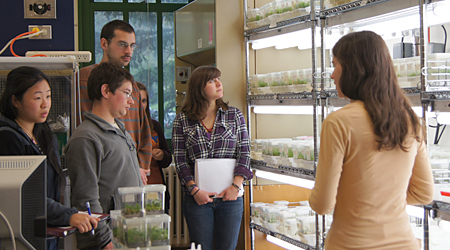
To prepare for this field trip, please review the observations I will expect you to make by going to the Field Trip Observations page.
I will also return Wednesday's ungraded quiz (Quiz #18). As always, you'll find a grading rubric and review video for this quiz here. Please email me your score (between 0 and 10 points) no later than midnight this coming Sunday, April 21.
Today and Wednesday will provide all of you with an opportunity to practice your presentation in preparation for this coming Saturday's Master Gardener volunteer training workshop.
We'll end the class with a quiz (Quiz #19). The content of the quiz will be cumulative - meaning it can cover anything that's been presented since the beginning of the semester. The intent of this quiz - and the one on Wednesday - is to help you reflect on how everything we've discussed this semester fits together. While this may be seem daunting - especially considering all of the demands on your time as the semester is winding down - keep in mind that the quiz is worth just ten points.
Finally, if you've not already done so, make sure you finish grading your third exam in preparation for our one-on-one review session this Friday!
The main objective of today's class will be to complete the practice presentations for this coming Saturday's Master Gardener training session.
We'll end the class with the last quiz of the semester (Quiz #20)! I will also return Monday's ungraded quiz (Quiz #19). You'll have until midnight this Friday evening, April 26, to email your score (between 0 and 10 as always) to me, using the Quiz 19 grading rubric and review video at this link.
By now you know the routine when it comes to these meetings.
Obviously, make sure that you've got your third exam graded and have a list of confusions ready to discuss. As important, I'll also want to spend a couple of minutes discussing the progress you're making on the various parts of your capstone project. Obviously, I've had the opportunity to watch your presentation and, hopefully, I've also seen your video, too!
I will also return Wednesday's ungraded quiz (Quiz #20). As always, you'll find a grading rubric and review video for this quiz here. Please email me your score (between 0 and 10 points) no later than midnight this coming Sunday, April 28.
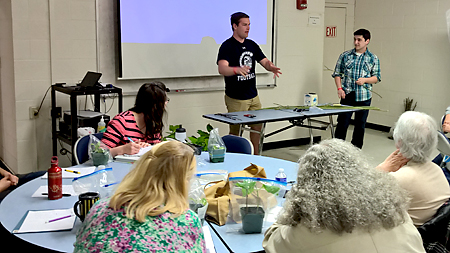
Case in point, in the image at right, two students in the Spring 2016 iteration of this class instruct Master Gardener volunteers on how to perform "whip and tongue" grafts. Both students, Alex and Tommy, later said that despite doing the readings, watching the video lectures, visiting Cummins Nursery and performing their own grafts in the grafting and budding lab, it wasn't until they were preparing for their workshop presentation that they really understood process from beginning to end.
Also, not to put additional pressure on you, but to quote from an email from Karen Bishop as she and I were arranging this workshop last fall, "Would it be possible to present this class again to my new group of MG trainees in the Spring of 2019? I know that this was a lot of work for both the students and you, but it was an excellent presentation, and rated the best training class by the previous group of Master Gardeners."
Though maybe wishful thinking, my hope is that instead of thinking TGIO ("Thank Goodness It's Over") as per the traditional Undergraduate Student Association end-of-semester event, you might be at least a little wistful that this class is coming to an end today.
With that in mind, we'll spend the first part of this last class session discussing Saturday's Master Gardener workshop - what worked, what didn't work, what you might do differently if you have a similar opportunity in the future, etc.
We'll then shift to the bigger picture and reflect on the complete course experience and discuss ways in which future offerings of this class can be improved.
I will be available from 9:30 until whenever I've addressed as best as possible all of your questions in preparation for the final exam, completing your lab reports, finishing your capstone manuscript, etc.