Plant Propagation
EFB 437/637
Field Trip Observations
As a student I typically thought of field trips as a "day off" from the daily grind of the semester. As an instructor, however, I have incorporated these field trips into the course to provide you with an opportunity to see first hand how many of the practices we have discussed in class are implemented on a commercial scale in the real world.
While you may never be responsible for propagating thousands/millions of plants per year, I will expect you to reflect on these opportunities and hopefully rely on your observations to support answers to quiz/exam questions, strengthen conclusions in your lab reports, and make your capstone project more impactful.
To encourage mindfulness during these trips, upon returning to the bus for the trip back to campus you will draw a number associated with the observations I suggest you make at the end of each field trip description. As you depart the bus, please hand to me a short discussion of the observation you've drawn - or another based on a personal observation you believe was especially interesting.
While it will be your choice to participate, each of these discussion pieces will be worth ten extra credit points added to your overall course grade at the end of the semester.
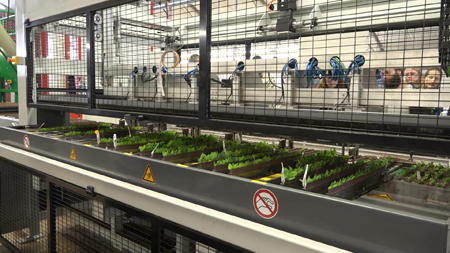
At Dickman Farms we'll see how technology - including an automated stem cutting sticking machine (at right) - allows them to produce so many plants with a relatively small staff. We'll also learn how they use various Integrated Pest Management (IPM) practices to significantly reduces/eliminate the need for pesticide applications.
In preparation for this field trip, please read pages 266-276 in the textbook. You will also find Chapter 40 - "Producing Seedlings and Bedding Plants" in the supplemental reference "Plant Propagation: Concepts and Laboratory Exercises" to be helpful in providing an overview of a number of the practices we'll observe during the trip.
Observations I encourage you to make include, though are not limited to:
- What types of media are used to propagate/grow the many different kinds of plants they produce?
- Where are the various unrooted cuttings they receive grown and how are they handled prior to being stuck?
- What is the relationship of rootzone temperatures to air temperatures during the rooting of cuttings?
- What is the advantage of the Ellepot system in relation to rootzone aeration?
- Discuss how is seed stored before it is sown?
- Under what conditions are seeded trays maintained to insure high germination rates?
- Describe the gantry watering system as if to someone that's never seen it.
- What are at least four practices Dickman Farms uses to reduce the need for pesticide applications throughout the propagation and production cycle?
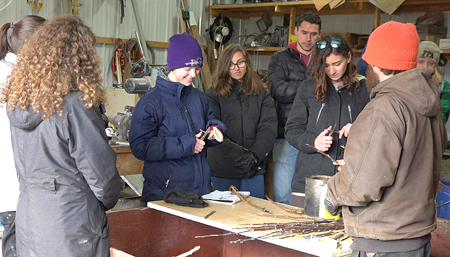
We'll begin our visit out in their fields (even if the weather is less than ideal) where we'll see their rootstock stool beds, scion/budwood trees, and one year grafted "liners." We'll also see a number of unique "topworked" apple trees that are being used to produce cider for sale at Indian Creek Farm, the retail farm market side of the business.
We'll complete the visit inside their workshop/cold storage facility where Steve and his crew will demonstrate the grafting and budding techniques they use to build their trees (at right, above), and how they prepare trees harvested last fall for shipping.
In preparation for this field trip, it would be a good idea to review the assigned content from Chapters 12, 13 and 14. In particular, make sure to watch the eight "Garden Journeys" segments I recorded with Steve Cummins about five years ago.
Observations I encourage you to make include, though are not limited to:
- Explain the function and advantages of a rootstock "stool bed?"
- Compare and contrast the management (pruning, size control, etc.) of scionwood stock tree versus a fruit-producing tree.
- Describe the complete production cycle (i.e., both rootstocks and scions) of overwintered liners we observe in the nursery field.
- Compare the structure and advantages of the old "top-worked" trees we observed out in the orchard as compared to liners in the nursery.
- Where are the rootstocks Cummins Nursery uses grown and how are they cared for before they're used in the grafting process?
- Where does the scionwood Cummins Nursery uses to produce grafted trees come from? Also describe the characteristics of an ideal piece of scionwood.
- Describe and provide a rough sketch of the "whip and tongue" graft Cummins Nursery uses to "build" the grafted apple trees it sells.
- To insure the graft "takes," explain how grafted trees are cared for between the time they're grafted and lined out into the nursery fields in May?
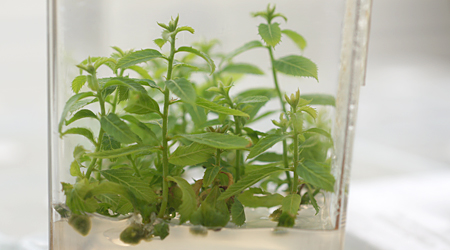
In preparation for this lab visit, it would be a good idea to review the assigned content from Chapters 17 and 18, and related videos. This shouldn't be too burdensome as you - hopefully - are already familiar with this material as some of it was covered in Exam #3.
Observations I encourage you to make include, though are not limited to:
- Briefly describe the four (five) key "stages" of plant propagation via tissue culture technques.
- What strategies are employed in order to obtain contaminent-free "explants?"
- What role might the management of "stock plants" play in the successful establishment of vigorous explants?
- Briefly describe the process of preparing aseptic culture media - i.e., ingredients, mixing, dispensing, disposal, etc.
- Tissue culture technicians spend a lot of time working in a "laminar flow hood." Briefly explain what this piece of equipment does and the general steps a technician performs in the hood.
- Tissue culture media contains all the ingredients explants require for growth. That being the case, explain why most aseptic cultures are grown under lights?
- The origin of new "plantlets" (axillary or adventitious) is critically important when attempting to obtain clones from a tissue culture system. Briefly explain the preference of one system versus the other as it relates to the propagation of true clones.
- Briefly discuss the challenges associated with rooting "microcuttings" and acclimating them to field conditions.