Course Capstone Project
Compared to the relatively temporary and shallow "just in time" understanding suitable for performing well on quizzes, exams, etc., that we all (yes, that includes me) rely on to "get by" so we can get on to the next thing on our (want) to-do list, learning science research shows that repeatedly putting information together in different ways, similar to repetition in the arts and competitive sports, reinforces the understanding of concepts and ultimately strongly supports a foundation for deep, life-long learning.
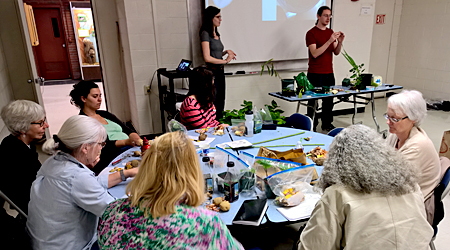
Therefore, in support of your learning in this course, this semester-long capstone effort will require you to put information on a propagation topic of your choice together several times in different ways including a short (roughly five minute) instructional video and a popular magazine-style manuscript suitable for submission to "Fine Gardening" magazine. With a partner, you will also prepare and deliver (i.e., teach) a roughly twelve minute lesson on your topic to ESF and SU students, staff and faculty during the week of April 24th - last full week of the semester.
Goals of this "deep dive" into a course-related topic include reinforcing your understanding of course content, providing you with an opportunity to practice a variety of public presentation techniques and creation of artifacts that will demonstrate your critical thinking and presentation skills to potential employers.
To help you pull together your plans for this project, I've pulled together the following resources:
The development of this assessment tool will be a collaborative effort among all of us. As with every assessment in this class, the focus will be on how effectively the effort supports your learning.
In addition to the magazine's website, I have placed two "hard copies" on reserve at the Moon library reference desk. I strongly recommend spending some time reviewing both the website and hard copy to get a sense of the magazine's "voice," its use of graphics, etc. I do think you'll be surprised by how brief many of the articles are as most people prefer looking at pretty pictures, flashy infographics, drawings, etc., versus reading a bunch of boring words!
Students in the spring 2017 Plant Propagation course conducted a full day workshop for Cornell Cooperative Extension Master Gardener trainees (turned out to be the same Saturday as "Redfest" - much to the dismay of several students in the class:-(
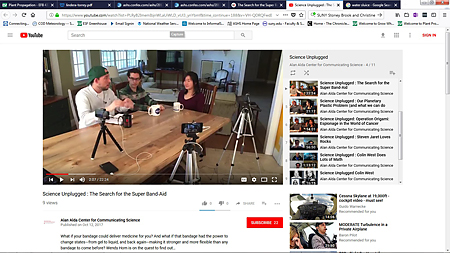
Meanwhile, for a "technical" thought on setting up your video recording, the picture at right, above, shows how cellphones on inexpensive tripods (I've got a couple you can borrow) can be arranged to capture a "three-shot" video interview. Click here to view a full size image of this cellphone set up.
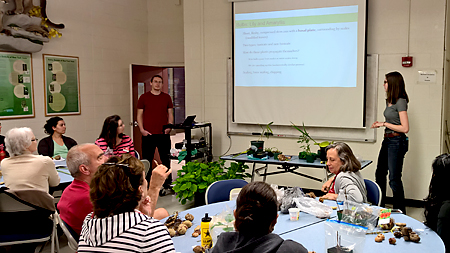
While your presentation will address the same content as your "Fine Gardening" article, consider “wrapping” it up in a compelling story. While your presentation needs to be factual, helpful, clear, concise and compelling, it doesn’t need to be boring!
To that end, while a Powerpoint presentation is fine, I encourage you to think of this presentation as a “safe” place to try out other presentation technologies such as Sway, Prezi, etc. Or, maybe even consider incorporating video components into your presentation using Techsmith’s Jing, Camtasia, or Snagit, Apple's IMovie, the Photos app in Windows 10, etc.
Below are links to the presentations delivered to Master Gardener trainees. (Note that despite my encouragement to try something new and different, almost everyone relied on Powerpoint . . . . . sigh.)
Budding and Grafting (Powerpoint link)
Introduction to Clonal Propagation (.pdf link)
Propagation by Layering (Powerpoint link)
Seed Propagation (Powerpoint link)
Seedling and Clonal Life Cycles (Powerpoint link)
Stem Cutting Activity (.pdf link)
The Beauty of Modified Stems (Powerpoint link)
Budding and Grafting (Powerpoint link)
As part of their effort, students in the Spring 2017 class also prepared short video presentations in support of their presentations that can be viewed by clicking on these links. (Note: these files are quite large so it may take a minute or two for them to download before they'll play.)
Propagation by Modified Stems (Video link)
Air-Layering a Rubber Tree (Video link)
Creating a Low-Cost Humidity Chamber (Video link)
Cutting Propagation Techniques (Video link)
Introduction to Budding and Grafting (Video link)
Introduction to the Cone of Juvenility (Video link)
Below are a list of the presentations students in the Spring 2018 Plant Propagation class delivered as part of a campuswide workshop.
Fern Propagation - Allison DeSario
African Violet Propagation - Jessie Brown
Hops in Central New York - Brenden Welch
The Versatility of Succulents Leads to Different Methods of Propagation - Kelsey McLaughlin
The Grafting of Fruit Trees - Elizabeth Sammons
The Hows and Whys of Apple Rootstocks - Marissa Lanzatella
How to Propagate Aquatic Plants - Rachael Christman
Propagation of Plants via Stolons/Runners - Tucker Schnaars
Saving Fruit Trees by Bridge Grafting - Gabriel Sanchez
Propagation or Trichocereus (Echinopsis) Cacti - Markus Lopez
Design and Construction of a DIY Propagation Chamber - Hunter Longenberger
Lilac Propagation - Porter Lesiv
Starting Pansies from Seed - Orena Wong
DIY Versus Synthetic Rooting Compounds - Emily Heifferon
Tips and Tricks for Propagation by Tissue Culture - Haley Sussman