Plant Propagation
EFB 437/637
Before making a huge mess as we slice and dice the better part of a hundred bulbs in this lab session, we're going to spend some time discussing how best to assess your effort and learning in this component of the class. To help organize this discussion, please download a copy of a blank assessment rubric.
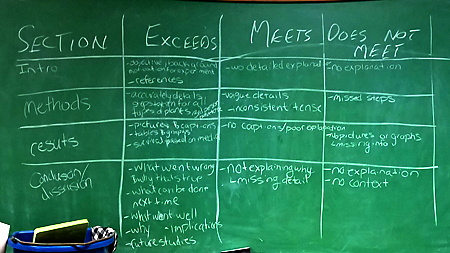
To help start the conversation, at right is a picture I took of the lab assignment assessment rubric that students in the spring 2017 iteration of this course developed. (You can open a much larger version by clicking here.)
I'm going to leave the room for about twenty minutes, during which I would like for you (the class) to discuss and fill in the rubric blanks. After twenty minutes, I'll return and we'll review and refine the rubric to insure that the assignments are as effective as possible in clearly communicating your experience and learning and - ideally - will be sufficiently rigorous to serve as an artifact that you can use as an example of your abilities to potential employers.
Once we've created an acceptable lab assignment assessment rubric draft (we'll further refine our thoughts regarding the preparation of your lab reports/stories during the March 1st lab session), I would like for you to answer the question below.
- A "bulb" is a type of root structure.
- A "bulb" is collection of compressed and modified underground leaves.
- A "bulb" is collection of compressed and modified underground leaves.
- A "bulb" is a complete plant featuring a root system, densely compressed stem, modified storage and photosynthesizing leaves, and a flower primoridia.
- None of the above.
The answer I'm looking for is "d."
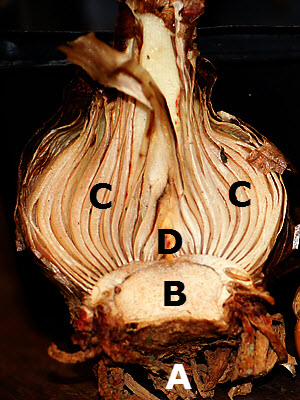
A bulb is, in fact, a complete plant featuring a root system, a densely compressed stem (referred to as a "basal plate"), modified storage and photosynthesizing leaves, and a flower primoridia. At right is a longitudinal section of a slightly dried amaryllis bulb that exhibits this structures; (A) root system, (B) compressed stem, (C) modified storage leaves, (D) flower primordia. We'll discuss the relationship of bulb anatomy to their propagation when we tackle the content in Chapter 16 - Propagation by Specialized Stems and Roots, in early April.
In this lab session we are going to take advantage of two unique traits of these mostly underground plants; the presence of "axillary" buds on the densely compressed stems (which are essentially the same as axillary buds along the stems of most plants), and the meristematically active regions at the base of modified storage leaves.
To aid in the efficiency of your efforts during this lab session, you can click on the link below to download and print the treatment matrices.
Bulb Propagation Treatment Matrices
I also strongly suggest that you read pages 642-658 in the text and and Chapter 30 - "Propagating Selected Flower Bulb Species" in the supplemental reference "Plant Propagation: Concepts and Laboratory Exercises."
Amaryllis Twin‐Scaling and Chipping:
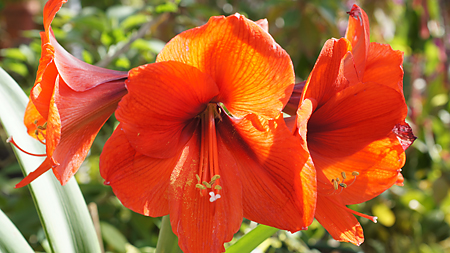
Because its production of flowers is relatively easy to schedule by means of environmental manipulation, it is often available for purchase in full bloom during the Christmas season, or sold as "kits" including a bulb, container and potting soil. It's also a common landscape plant across much of the southern U.S. and Pacific coast.
In this exercise, you will create two types of propagules from a single amaryllis bulb; "chips" and "twin-scales." You will also examine the influence of propagule size and propagule location on the basal plate (twin-scales). And, as a class, we'll pool our data to see if propagation media plays a role in the success of these techniques.
To prepare for this exercise, please watch the video instructions below and consider the following questions.
- What roll might the size of the propagules play in the success of this exercise?
- Why is it important to retain a piece of the basal plate with each propagule regardess of size?
- How might the appearance of a "daughter" bulb at the base of a mature amaryllis relate to any results you might obtain in this exercise?
- Based on your current knowledge of and experience with various media used in plant propagation systems, which of the four media used in this exercise do you believe will be most successful?
Amaryllis Chipping (Link)
Amaryllis Twin-Scaling (Link)
Lily Scaling:
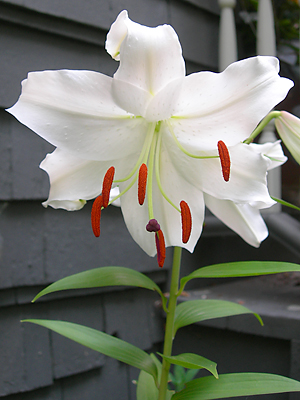
Possibly the best known of all lily species is the Easter lily, Lilium longifolium, at right. Native to both Taiwan and the Ryukyu Islands of southern Japan, nearly all commercially-grown Easter lily bulbs are produced on about five farms in a very small coastal region centered around the community of Smith River in northern California. As a result of the intensive production practices used to grow a high quality bulb crop on the same fields since he 1940s, there is now significant concern over potential environmental impacts to this small community.
In this exercise, you will propagate an unnamed Asiatic hybrid lily (most likely) by "scaling." As outlined on pages 654-655 of the textbook, you will examine the influence of propagule location on the basal plate and the propagation environment (plastic bag versus plastic tray). As a class, we'll also again pool our data to see if propagation media plays a role in the success of these techniques.
To prepare for this exercise, please watch the video instructions below and consider the following questions.
- What, if any, visual/physical differences are there between the "outer" and "inner" scales?
- What is the advantage(s) of placing scales in plastic bags versus trays? Should the trays be placed in plastic bags?
- How might the various media effect the rate of success of this exercise?
- What other questions do you believe would be important to ask?
Lily Scaling (Link)
Hyacinth Scaling, Scooping and Scoring:
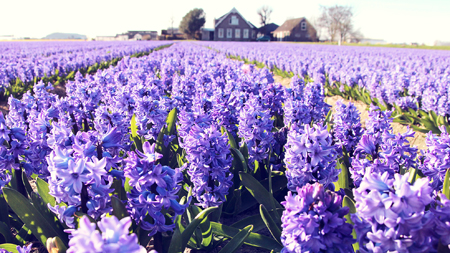
Like both amaryllis (i.e., Hippeastrum) and Easter lily, the intensely fragrant-flowering hyacinth is quite easy to force into bloom. Therefore, it's quite common to find them for sale as flowering potted plants near grocery store checkout lines in late winter through early spring here in Central New York, the better part of two months ahead of their typical bloom date in outdoor landscape plantings.
In this exercise you will be given two hyacinth bulbs. With one you will explore the role of "scale" propagule size and growing environment (plastic bags or media filled trays) on propagation success. The second bulb you will be assigned to either "scoop" or "score." And, as a class, we'll again examine the influence of propagation media.
To prepare for this exercise, please watch the video instructions below and consider the following questions.
- What roll might the size of the propagules play in the success of this exercise?
- Why is it important to retain a piece of the basal plate with each propagule regardess of size?
- How might the appearance of a "daughter" bulb at the base of a mature amaryllis relate to any results you might obtain in this exercise?
- Based on your current knowledge of and experience with various media used in plant propagation systems, which of the four media used in this exercise do you believe will be most successful?
Hyacinth Scaling (Link)
Hyacinth Scooping (Link)
Hyacinth Scoring (Link)