Plant Propagation
EFB 437/637
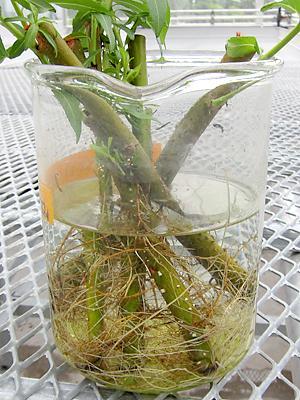
Obviously, as we're not even a full week into the course, you're going to be making a leap of faith that the techniques you'll be using will actually work (of course, there's also a chance they won't work and you'll need to explain to me and your classmates why they didn't work). I am also going to ask you to consider a number of questions relating to each of the techniques right now that we won't really start discussing in detail until the sixth week of the semester. While you may find this to be a bit frustrating, I'm hopeful that by considering these questions now, you'll be well-prepared to reconsider them should I ask you to submit one or more of these exercises for assessment later in the semester.
To aid in the efficiency of your efforts, you can click on the link below to download and print the treatment matrices for this lab session.
Cutting Propagation Treatment Matrices
Root Cuttings:
While now rarely used on a commercial scale because of advances in stem cutting and micropropagation techniques/technology and the difficulty of harvesting and preparing large quantities of propagation material, root cuttings do offer a relatively low-tech, low-cost option for propagating small quantities of many species.
Therefore, working with a partner, you will prepare root cuttings of an assigned woody and herbaceous perennial species. Depending upon whether/where the ground is frozen we may be working with oakleaf hydrangea (Hydrangea quercifolia), bottlebrush buckeye (Aesculus parviflora), Japanese anemone (Anemone hupehensis), staghorn sumac (Rhus typhina), redtwig dogwood (Cornus sericea, syn. C. stolonifera), roundleaf dogwood (Cornus rugosa), bluestars (Amsonia tabernaemontana), and/or elderberry (Sambucus canadensis).
Variables you will explore include root diameter - "large" or "small" (sizes will vary depending upon the species) and air/media temperature. Therefore, I encourage you to begin your research efforts by learning more about how these variables have influenced previous root cutting propagation efforts.
Other questions to consider include;
- How are you going to determine what is a "large" versus "small" root cutting?
- How do the root cuttings of your species visually compare to those of other species?
- How are you going to orient your cuttings - i.e., horizontally, vertically, etc.?
- How will you monitor treatment variables?
- How are you going to measure treatment differences at the conclusion of the study?
- While tangentially-related to plant propagation, reflect on why "weedy" plant species capable of regenerating from root pieces can be especially difficult to manage/control.
(Note: in preparation for this part of the lab session, read Chapter 23 - "Adventitious Shoot and Root Formation on Leaf and Root Cuttings" in the supplemental reference "Plant Propagation: Concepts and Laboratory Exercises." Also review the following video instructions.)
Root Cutting Introduction
Leaf Cuttings:
Similar to propagation by root cuttings, few species are propagated by leaf cuttings on a commercial scale - partially because few species are capable of clonal reproduction by leaf cuttings, and those that can reproduce from leaf cuttings infrequently do so in commercially efficient numbers.
Regardless, to gain experience with this form of clonal propagation, during the second part of this lab session each of you will propagate either a rhizomatous or cane begonia (Begonia sp.), as well as both sanseveria (Sanseveria trifasciata) and ZZ plant (Zamioculcas zamifolia) from leaf/leaflet cuttings. Note, however, from the Cutting Propagation Treatment Matrices that while you will propagate each species, your efforts will be single "replications" of specific treatments. Therefore, you're going to want to get together with your "replicates" to coordinate initial observations and measurements, cutting techniques, day-to-day management of propagules throughout the exercise, end of exercise data collection, etc.
To help you think through your leaf cutting propagation effort, below is a short (definitely not exhaustive) list of questions to jumpstart discussions with your replicate mates. You'll also find several species-specific questions below several of the video instruction links. (All questions also appear on the various treatment matrices).
- Besides the physical size of the propagules are there other propagule-related traits, growing conditions, etc. that should be noted/measured at the beginning of the exercise?
- What is your plan for monitoring environmental conditions (e.g., light intensity/duration, temperature, humidity, media moisture, etc.) for this exercise? Is it even necessary?
- At the conclusion of this exercise, what will you measure to detect possible differences between treatments?
(Note: To prepare for this part of the lab session, please watch the following video instructions. I also suggest you read pages 360-361 in the text and Chapter 24 - "Propagation by Leaf Cuttings" in the supplemental reference "Plant Propagation: Concepts and Laboratory Exercises.")
Leaf Cutting Introduction (1:08 minutes) (Link)
Sanseveria Leaf Cutting Propagation (5:22 minutes) (Link)
- Why are alternating leaf pieces inverted?
- In addition to orientation of the leaf pieces, what other factors might impact the success of these leaf cuttings?
- How will you measure/document these factors at the beginning of the exercise and incorporate them into your findings at the conclusion of the exercise?
Begonia Leaf Cutting Propagation (3:52 minutes) (Link)
- What is the significance of cutting across the vascular tissue (veins) of begonia leaf cuttings?
- Which cutting type - whole, pieces or rolled - do you believe will result in the greatest success? Why do you believe this?
- How will you measure success - roots, shoots, or only complete new plant(lets)?
ZZ Plant Leaf Cutting Propagation (2:15 minutes) (Link)
Hardwood Stem Cuttings:
As mentioned in the entry for this lab session on the Course Schedule webpage, the rooting of stem cuttings is the most common of all "clonal" (there's that term, again) propagation techniques. Because it's so common, many people assume that all you need to do is apply a rooting compound to stem cuttings and new roots will magically appear in short order. However, as you'll learn over the course of the semester, that's often not the case.
In this exercise, you and your teammate will develop an appreciation for the complex interaction of endogenous "phyto" hormones, externally applied rooting compounds, stock plant vigor, propagation environment, etc., by using hardwood stem cuttings to propagate the following upstate New York native woody shrubs; `Gro-low' fragrant sumac (Rhus aromatica `Gro-low'), dune sandcherry (Prunus pumila), redtwig dogwood (Cornus sericea, syn. C. stolonifera) and horizontal juniper (Juniperus horizontalis).
Questions relating to hardwood cuttings of these species for you to consider include (but are not limited to):
- What is the condition of the "stock plants" from which cuttings have been collected?
- Are there any stock plant traits that lead you to believe these species can be propagated from hardwood cuttings?
- If the the "active ingredient" - i.e., the synthetic rooting compound, IBA - is the same whether applied in a dry powder or liquid form, why would you use one versus the other? Do you anticipate one form working better than the other?
- How do you plan to manage the propagation media moisture levels?
- How will you insure your propagules are sufficiently uniform so that you can trust that your observations are due to treatments?
- What data will you collect when this exercise is terminated? What is your rational?
(Note: To prepare for this part of the lab session, please watch the following video instructions. I also suggest you read Chapter 17 - "Cloning Plants by Rooting Cuttings" in the supplemental reference "Plant Propagation: Concepts and Laboratory Exercises.")
Hardwood Stem Cutting Lab Overview (4:15 minutes) (Link)
Redtwig Dogwood Hardwood Stem Cutting Preparation (3:05 minutes) (Link)
Horizontal Juniper Hardwood Stem Cutting Preparation (3:08 minutes) (Link)
Juniper Hardwood Cutting Tip (1:54 minutes) (Link)
Gro-low Fragrant Sumac Hardwood Stem Cutting Preparation (3:02 minutes) (Link)
Sandcherry Hardwood Stem Cutting Preparation (1:56 minutes) (Link)
Talc IBA Formulation Application (2:03 minutes) (Link)
Liquid IBA Formulation Application (2:19 minutes) (Link)