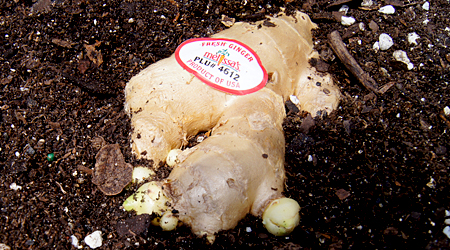
We propagated several bulb-forming geophytic plants (amaryllis, lily, and hyacinth) by scaling, twin-scaling, chipping, and scooping during the second lab session of the semester on January 25th. While we won't discuss the propagation of geophytic plants until the first week in April in the lecture part of the class (Chapter 16 - Propagation by Specialized Stems and Roots), we're going to propagate more geophytic plants in this lab session including gladiolus ("corm"), canna and edible ginger (at right) ("rhizome"), potatoes and caladiums ("tuber"), dahlia ("fleshy tuberous root"), tuberous begonia ("tuberous stem"), and orchids ("pseudobulb") by various "division" techniques.
For an overview of what we're going to be doing in this lab, please watch introductory video below.
Gladiolus is the largest genus (approximately 255 species) in the Iridaceae family. Most are native to South Africa, but a few are native to southern Europe, the Middle East and Madagascar. The vast number of hybrids created over the past several hundred years is easily in the tens of thousands - just a very few of which are exhibited every year at the New York State Fair (at right)!
Gladiolus are typically clonally propagated via "cormels" - essentially tiny corms borne at the tips of stolon-like structures (we'll discuss propagation via stolons a bit later in the semester) emerging from the base of new corms in late summer/early autumn. However, it can take three to four growing seasons for cormels to grow into full-sized corms that are capable of producing flowers.
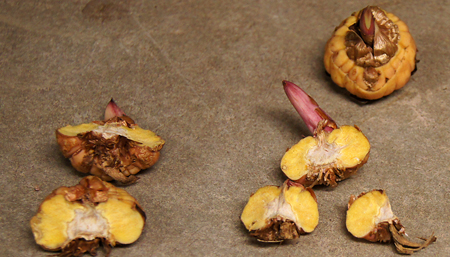
To obtain a large number of flowering-sized corms in one or two growing seasons, corms can be divided in half and sometimes - depending upon the vigor of the parent corm - into quarters (as at right). This division disrupts apical dominace within the corm (which is a densely compressed stem), allowing dormant axillary buds on each division to grow into corm-producing stems.
To prepare for this exercise, please watch the video instructions below and consider the following questions.
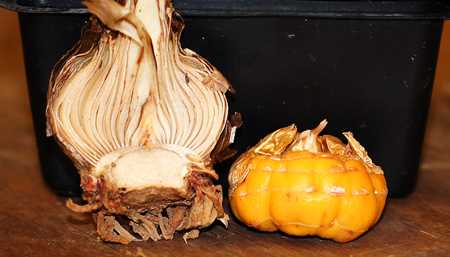
Compare the structure of a bulb and a corm, both of which are compressed stems. While they may not look that similar at first glance, they really aren't that different. You may find the image at right to be helpful?
Based on your current knowledge of and experience with various media used in plant propagation systems, which of the four media used in this exercise do you believe will be most successful?
Propagating Corms By Division (12:08 minutes) (Link)
Propagating Rhizomes By Division (9:58 minutes) (Link)
Propagating Tubers By Division (9:07 minutes) (Link)
Propagation of Tuberous Roots by Division (8:01 minutes) (Link)
Propagation of Tuberous Stems by Division (6:22 minutes) (Link)