Plant Propagation
EFB 437/637
Course Schedule - Week 6
Watching an entire plant slowly emerge from a seed is nothing short of amazing. However, even after forty years as a professional horticulturalist I still find the appearance of tiny roots on the base of a stem cutting, tiny shoots emerging from a leaf cutting, "bulblets" appearing out of nowhere around the base (technically the "basal plate") of a hyacinth bulb, and/or the successful "budding/grafting" of one plant onto another to be nothing short of miraculous!
All of the events described above are forms of "clonal" propagation - i.e., the vegetative/asexual production of progeny plants that share an identical genotype with a single source (parent) plant. In fact, you've already experienced several forms of clonal propagation in lab sessions earlier in the semester.
We'll jump into clonal propagation - the focus of the rest of the semester - by discussing the relationship between the seedling and clonal lifecycles, the advantages/disadvantages of clonal propagation, possible sources of clones as cultivars, and types of variation within clones.
We'll end the class with a quiz (Quiz #6) covering content from Chapter 9 and related videos and readings (again, note that this content is found in Chapter 16 of the 7th and 8th editions of the assigned textbook).
(Reminder . . . . , please remember to review and self-grade your first exam. I will be meeting with each of you during this coming Friday's lab session to discuss the exam and assign a mutually agreeable grade.)
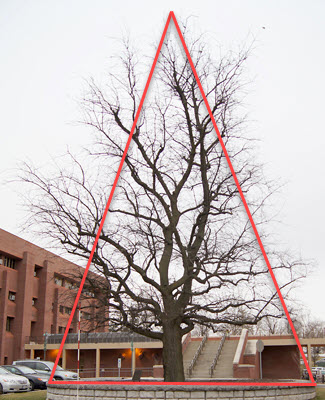
Typically, plants are most easily propagated from cuttings, grafting, layering, etc. within a relatively short period of time (days, to months, to years depending upon the plant) following their germination from a seed. However, even very (chronologically) old plants can retain ontogenetically juvenile characteristics at the "root/shoot junction" formed ("laid down") at the time of seed germination.
We'll complete our discussion by overlaying of the "cone of juvenility" onto examples of various sexually mature plants, including our own `Robin Hood Oak' (at right) to better visualize chronological age versus ontogenetic age and therefore increase your chance of success with clonal propagation techniques.
As always, we'll end the class with a quiz (Quiz #7) and I'll also return your ungraded Quiz #6. You'll find the rubric for Quiz #6 here. Please email me your score (between 0 and 10 points) no later than midnight this coming Friday, February 21.
And, to prepare for our discussions and lab exercises leading up to the second exam just prior to spring break, please read Chapter 10 and Chapter 11 (and watch the related videos and complete the additional assigned readings). In the supplemental reference "Plant Propagation: Concepts and Laboratory Exercises" you'll find Chapter 14 - "Plant Growth Regulators Used in Propagation" as well as Chapters 17 through 25 (which cover specific components of the material covered in Chapters 10 and 11 of the assigned text) to be helpful.
Today will be very busy for me as I'll be meeting with each of you for roughly ten minutes(ish) to review your first exam effort, assign a mutually acceptable score, and at least briefly discuss the progress you've made on your capstone project (at an absolute minimum I believe you should have a pretty good grasp of the literature and other resources that are available on your topic). I will also return Wednesday's ungraded quiz (Quiz #7). As always, you'll find a grading rubric and review video for this quiz here. Please email me your score (between 0 and 10 points) no later than midnight this coming Sunday, February 23.
Meanwhile, Tucker will be working with you in the classroom to initiate the seed dormancy lab exercise that was originally planned for last week (as you may recall, we "chipped" and "twin-scaled" amaryllis bulbs in last week's lab).
I also strongly recommend using today as an opportunity for taking really detailed measurements and making close observations (including pictures) of your ongoing lab projects. As I've said, in past years I've been too forgiving if students didn't make a good effort to keep they're propagules alive (forgetting to water, etc.). That won't be the case this year. To understand how various propagation practices work, you have to keep your plant materials alive!