Plant Propagation
EFB 437/637
Course Schedule - Week 1
No class - Martin Luther King, Jr. holiday
My hope is the information available on this website will answer most of the questions you might have regarding how this class will function. Therefore, on this first day of the semester we're not going to review the syllabus, the course schedule, the required textbook, etc.
Rather, I want to focus on you.
First, you're likely nearing the end of your undergraduate college experience or are in grad school. Therefore, considering your many years of formal education experience, I would like for you to ask yourself . . . . .
Why have you gone to college?
What do you want to receive from me and this class in return for your investment of time and tuition (somewhere between roughly $500 and $1,500)? In other words, why are you taking this class and what do you want to be able to do after taking this class that you can't do now? (This doesn't necessarily need to be only propagation-related - e.g., learn to use "Prezi," learn to make an instructional video, be more confident teaching other people, etc.)
Next, I would like for you to reflect on the following questions.
In the best class you've ever taken, what did the teacher/instructor do? What did you and your classmates do in that class?
In the worst class you've ever taken, what did the teacher/instructor do? What did you and your classmates do in that class?
And, possibly most important . . . .
How can I help you realistically assess and communicate your learning over the course of the semester?
And, to get a sense of what you already know about plant propagation, I would like for you to complete - to the best of your current ability - the "Prior Knowledge Survey" for this class. You can download a copy by clicking here. Please complete it and email it to me by midnight tonight. While I encourage you to practice writing clearly, concisely and compellingly, please don't agonize over this exercise as I don't expect you to be familiar with most of these concepts (if you are, then maybe you should be teaching this class versus taking it). Rather, it's meant to serve as a baseline against which to measure your learning over the course of the semester.
Looking ahead to Friday's lab session:
- Read through all of the Lab Session #1 - Bulb Scaling, Scooping and Scoring instructions and watch the instructional videos (Note - you should be ready to perform the lab exercises when you walk in the door as we won't spend half the lab going over the activity as in lab sessions in many other classes),
Finally, looking ahead to next week's classes, a couple of reminders.
- In preparation for next Monday's class watch all of the Chapter One videos and complete all of the assigned readings.
- Start working through the Chapter Two content (readings, video lectures, etc.) on the seedling and clonal life cycles as we'll start discussing them in class next Wednesday.
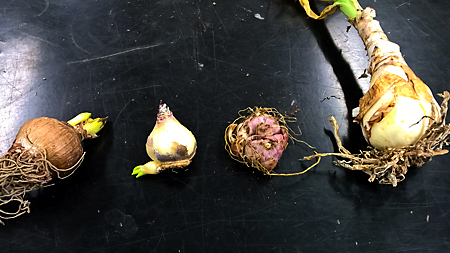
We will not discuss in detail the propagation of geophytic plants until the first week in April. However, for a brief introduction to this fascinating (at least in my opinion) group of plants please read the first seven pages of this recent American Journal of Botany review, "Get the Shovel: morphological and evolutionary complexities of belowground organs in geophytes." Despite the stuffy title it's actually a pretty easy read. You can download a copy of this review by clicking here.
In this lab session we're going to "scoop," "scale," and/or "chip" several bulb-forming geophytes including from left to right in the image at right, above; amaryllis (Hippeastrum x hybrids), lilies (Lilium x hybrids), hyacinth (Hyacinthus orientalis) and crinum (Crinum x hybrids). (Looking ahead, we will propagate additional geophytic plant species by means of corm, rhizome, tuber, fleshy tuberous root and tuberous stem "division" during Lab #7 on Friday, March 10th - yes, the afternoon just before the beginning of spring break).
For more information on this lab session including treatment rubrics and video instructions, click on this link Lab Session #1 - Bulb Scaling, Scooping and Chipping.