Plant Propagation
EFB 437/637
Course Schedule - Week 8
We'll spend today reviewing the topics we've covered since the first exam including the introduction to clonal propagation concepts and the propagation of plants by means of cuttings in preparation for the second exam of the semester coming up on Wednesday.
Second Exam!
Content covered will primarily include all assigned readings, videos, and web resources, in-class discussions and problem-solving exercises covered since the first exam. However, I won't rule out going back to the first day of the semester in order to reinforce your efforts to tie all concepts together as you work toward a thorough competency in propagating plants.
Once again, the format for the exam will be similar to the first exam and daily quizzes.
As with the first exam and quizzes, I will scan the exams and return them to you at the beginning of this Friday's lab session. You will then grade your own exams by referring to the second exam grading rubric and review video in preparation for a one-on-one exam review with me during the first lab session after spring break (that is, Friday, March 20).
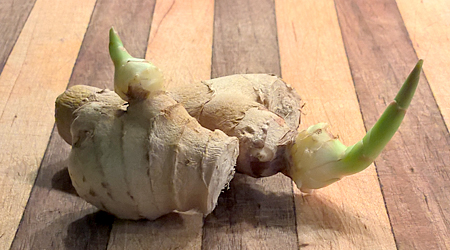
In this lab session we'll propagate several additional geophytic plants using various "division" techniques. The plants will include gladiolus (a "corm"), canna and edible ginger (at right) that both feature "rhizomes," potatoes and caladiums, (both are "tubers"), dahlia (a "fleshy tuberous root"), tuberous begonia (a "tuberous stem"), and coconut orchid ("pseudobulbs").
For more information on this lab session including treatment rubrics and video instructions, click on this link, Lab Session #7 - Geophytic Plant Propagation.
And, before you head out the door make sure that I've returned your ungraded Exam #2! While it's much longer delay than I would prefer, we'll meet to discuss your effort on Friday, March 20. Instead of waiting until the last second to grade your work, I strongly recommend you do it as soon as possible so that your reasoning for the answers you provided are still fresh in your memory.